
Compare and contrast pricing across Gin and Gin Gifts, distilled with deep segmentation and filtering
Know the competitive position of each retailer across categories and in key PLP positions
Investigate how retailers approach email marketing, when and how do they engage their audience
Compare and contrast the customer experience throughout the sales funnel and at key touchpoints
Who's included
Gins 'n' Roses compares six well known UK based gin retailers





Read the report
A review of the data and key insights
Executive Summary
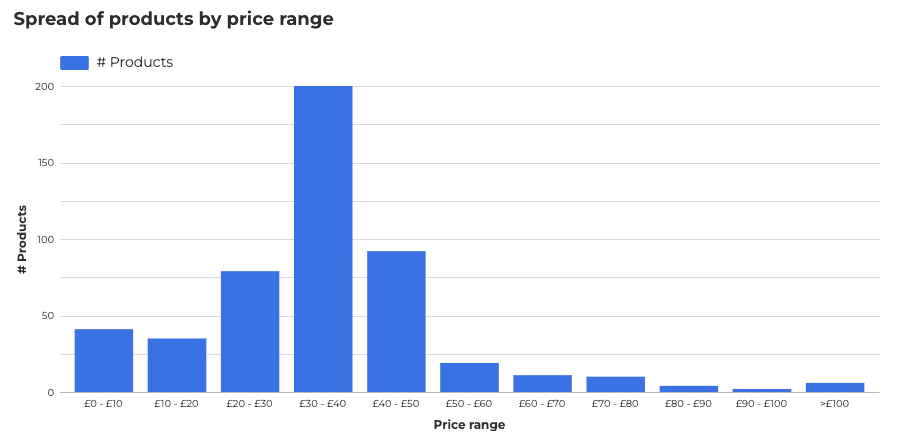
Across the six retailers included in the benchmark we see significant variation in product price with the range in average price by retailer extending from £20 at the lower end (Edinburgh Gin) to £55 at the higher end (Brighton Gin) but with the majority of products falling in the £30 - £40 price range.
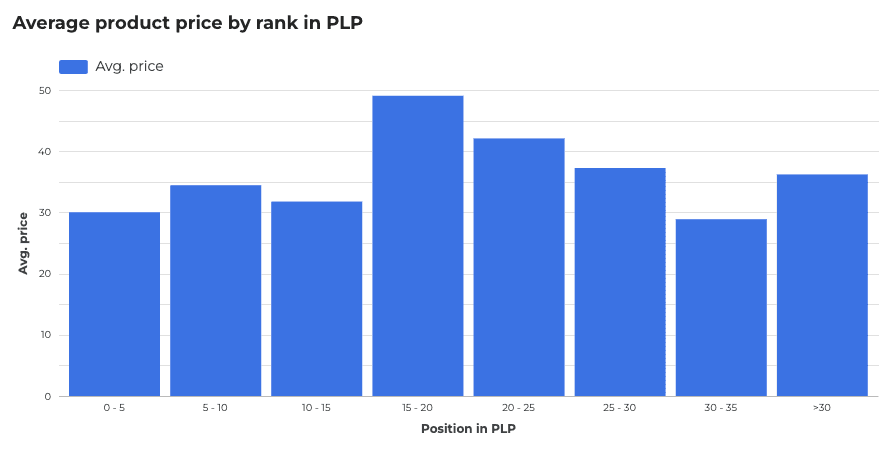
Furthermore, pricing data reveals how retailers are prioritising lower-price products within the PLP experience with the average price of products in position 1-5 being £30 compared to the average price of products in position 15-25 being £50.
The data suggests that price sensitivity and pricing competitiveness are tactical priorities for these retailers but customer experience benchmarking points to multiple failures to align customer experience with price position, product discovery lacks key features in many cases and the customer experience for product engagement is highly transactional, focused less on building a customer relationship, rather prioritising pushing users to buy as quickly as possible but at the potential detriment to lifetime customer value.
This focus of the customer experience on maximising sale rather than engagement is despite there being minimal customer engagement with purchase de-risking or use of urgency messaging, this suggests an approach to customer engagement that has been so heavily distilled that it now lacks key information required by users not only to find a product but also to inform and justify a purchase; there is minimal information regarding delivery, little use of urgency messaging and a general lack of effective product engagement across retailers included in the benchmark.
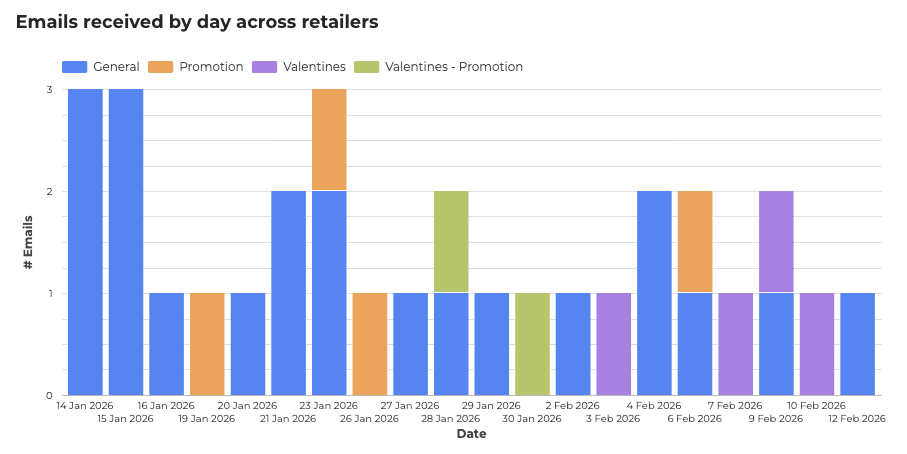
These themes in customer experience are also apparent when we consider email marketing, despite valentines day being an opportunity to drive user engagement and conversion through gift sets (in this benchmark we focused on gin) we received few emails related to valentines day and no flurry of emails on the 12th and 13th February building urgency; "buy it now have it delivered in time" for instance.
Overall, the benchmark highlights a widespread opportunity for retailers not only to align their pricing strategy with their customer experience but also to widen their scope of activity throughout the digital customer experience to capture the next big opportunity… Mothers Day.
Price
Average product price shows significant variation across retailers included in this benchmark, from the lower end of £20 (Edinburgh Gin) to £55 at the higher end (Brighton Gin), however this is not entirely surprising given the range in products included within both Gin and Gin Gifts (liqueurs, 5cl bottles etc.)
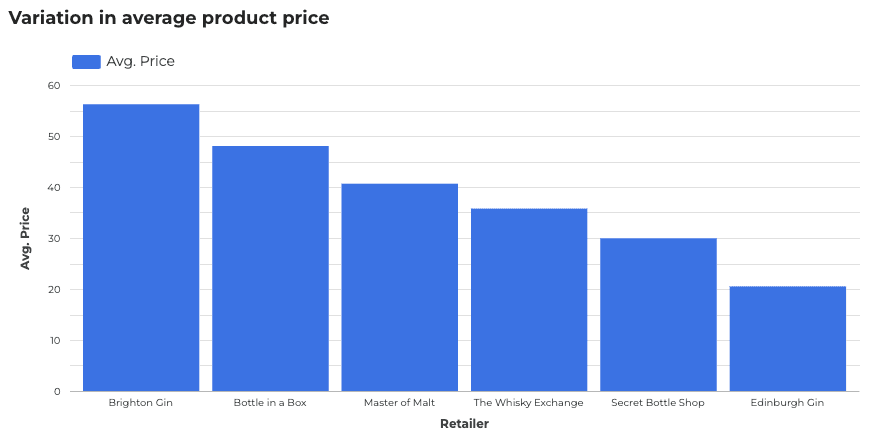
However, whilst there is significant variation in average price - indicative of a wide spread in product pricing across small gift boxes through to multi-70cl cases, when we look at the number of products by price range we see the majority of products fall in the £30-£40 range, similarly analysing price competitiveness across retailers suggests that most products fall within a relatively finite price window.
Position
When we consider price of products according to position within the PLP we see that as position falls i.e. the product moves further down the PLP so price increases - evidently retailers are prioritising their more competitively priced products higher in the PLP.
Customer experience
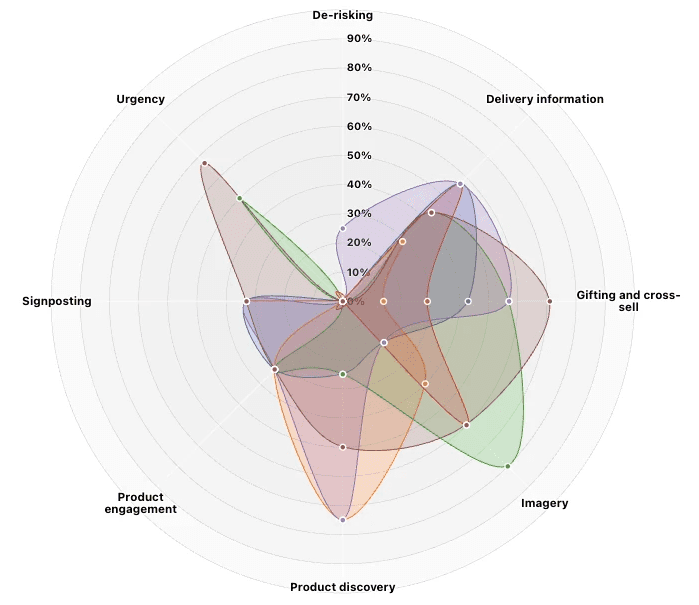
Whilst there is a degree of variation in customer experience across retailers, we see several consistent themes and opportunities for retailers to gain the advantage.
There is a consistent lack of effective delivery and de-risking messaging throughout customer experiences, particularly within the PDP and cart. Retailers do not communicate delivery costs, timeframes or, more importantly, packaging clearly and consistently - customers are expected to buy glass bottled products without being told how they are packaged and delivered.
Similarly, few retailers make effective use of urgency messaging, particularly regarding delivery time frames but also with regard to product availability and user engagement; there are few examples of "selling fast", "in x basket" or "last few" type messages that we saw, however some retailers do present stock availability information within the PLP.
Thirdly, there is significant variation in the quality of customer experience with regard to product discovery, whilst some retailers are strong in this regard there it is more common for PLP experiences to lack effective messaging and filtering for example bottle size, price or flavour profile.
Bottle in a box
Edinburgh Gin
Secret Bottle Shop
Brighton Gin
The Whisky Exchange
Master of Malt
Email marketing
Granted, Valentines Day may not be as big a trading period for digital spirits sales as it is in other categories, for example flowers (see part 2), but there remains an opportunity to drive sales through targeted marketing of the gifting proposition, this being of at least moderate focus for the six retailers included in the benchmark given that they all offer a gin-gifts category.
This throws the apparent lack of email marketing in the weeks preceding valentines day into sharp relief, despite registering and opting in to all email marketing communications we received minimal email volumes and there is little evidence to suggest that retailers have followed a clear strategy for capturing traffic in the week running up to valentines day.
This represents a significant missed opportunity.